Text & fonts#
slikui rasterizes TrueType text itself - vendored public-domain stb_truetype/stb_rect_pack compiled with internal linkage, no system dependencies, no icon fonts.
Loading a font#
A Context has exactly one active font. Load it from a file, or from memory:
#include <slikui/text/system_fonts.hpp>   // find_system_font()
#include <slikui/text/default_font.hpp>   // optional bundled subset

ctx.load_font_file(slikui::find_system_font());          // system TTF
// or, for identical text everywhere - even on machines with no fonts:
ctx.load_font_memory(slikui::text::default_font_data(),
                     slikui::text::default_font_size());
slikui::find_system_font() searches the usual per-platform paths and returns
an empty string when nothing is found - check the return of load_font_file
and fall back to the bundled font.
Font families and styles#
Beyond the body font, register more faces by family name. Three names are
roles every text call understands - "body" (what load_font_file loads),
"heading" and "mono" - and any other name is your own. An unregistered
family falls back to body.
ctx.add_font("mono", "/path/JetBrainsMono-Regular.ttf");
ctx.add_font("body", "/path/Inter-Bold.ttf", slikui::text::FontStyle::Bold);

// Installed fonts by role and style (.ttc faces resolved for you):
if (auto f = slikui::find_system_font_face("mono"))
    ctx.add_font("mono", f.path, slikui::text::FontStyle::Regular, f.face);
Bold and italic never need a font file: when a family has no face for the requested style, slikui synthesizes it from the closest face it has (italic slants the outline, bold thickens the glyph). Real faces look better, so register them when you ship them.
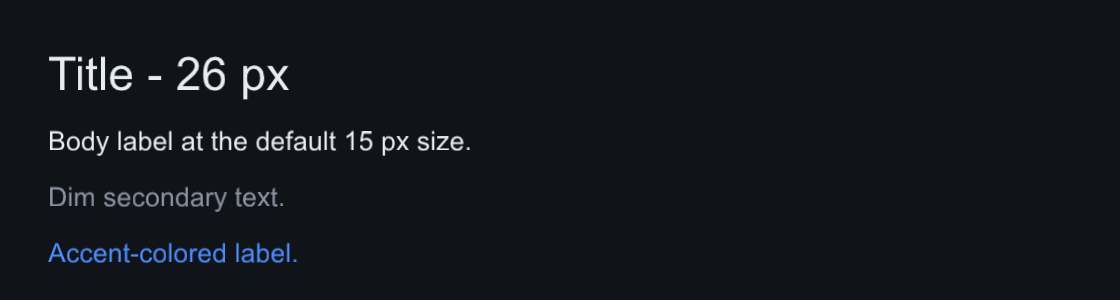
Underline and strikethrough use the font's own placement metrics and draw in
the text color. Label takes all of these as setters:
Custom widgets draw text with the same options through env.text - see
Custom widgets.
The bundled font#
The single-header dist/slikui.hpp bakes in a ~35 KB DejaVu Sans subset
(ASCII, Latin-1 + punctuation) so text renders identically everywhere, even
on headless containers. Building from the include tree the same font stays
opt-in: #include <slikui/text/default_font.hpp>. The Python wheels use
it as the fallback whenever no system font exists.
Licence: third_party/fonts/LICENSE-DejaVu.txt - ship it with your app.
How glyphs reach the screen#
- Each font face owns its TTF bytes, an stb_truetype fontinfo, a glyph cache and an alpha8 atlas of 512x512 pages. Glyphs rasterize on demand; when a page fills, a new page (with its own texture id) is added, and dirty pages are pushed to the sink.
- The cache is keyed by glyph, size (rounded to 1/4 px) and synthesized style, so bold and regular text at the same size coexist.
layout(text, px, max_width, flags)produces positioned glyphs with word wrapping, per-line byte ranges, and underline/strikethrough bars;advance_uptopowers caret hit-testing in text fields.- Layouts are cached per widget (
Label,ListView,Tabs) and invalidated on text or size changes;env.textlayouts are cached by the context and dropped after about two seconds unused. - Whitespace glyphs are never drawn.
- Glyphs re-rasterize automatically when
theme().scalechanges (window dragged between displays).
Sizing and wrapping#
Theme metrics set the base size (theme().base_font_px); individual widgets
override with set_font_size. Label word-wraps with set_wrap_width; with
no explicit width it wraps to the constraint width, so narrower windows
produce taller text blocks automatically.